Karna was a great warrior, some might say on par with Arjuna himself. Driven by loyalty and a longing for recognition, he allied himself with Duryodhana and his brothers, the Kauravas. Despite possessing a righteous heart, Karna committed many unrighteous deeds. Was Karna a tragic hero who was unustly denies the fruits of his heritage, or did he deserve his fate?
Birth and Early Life
Kunti, the adopted daughter of King Kuntibhoja, received a powerful mantra from the sage Durvasa, which could summon gods to bless her with children. Durvasa, pleased with Kunti’s devoted service, gifted her a divine mantra with the promise:
“If you invoke any god with this mantra, that god will appear before you and bless you with a child equal to him in glory.”
Kunti, out of curiosity, decided to test the mantra by invoking Surya, the sun god. Surya appeared in his radiant form, and Kunti, taken aback, said:
“I invoked only out of my curiosity, Lord. Please go back to your abode.”
Surya, bound by the power of the mantra, replied:
“You have invoked me with the special mantra that gives children. I cannot disobey the mantra, or the purpose of invoking me will be futile. I must bless you with a child. Or if you refuse, I will curse you and all of your loved ones.”
Kunti chose to obey Surya, asking him to bless her while retaining her chastity and ensuring the child would be born with an invulnerable chestplate and earrings. Surya granted her wish, and in ten months, Kunti gave birth to a boy, whom she kept secret. The boy was born with a golden chestplate and earrings. In the middle of the night, Kunti hesitantly placed the boy in a box and floated it on the Asva River, hoping for a better fate for her son.
Adoption and Upbringing
The basket carrying Karna floated through several rivers until it reached the city of Champa, where Adhiratha, a charioteer of Dhritarashtra, and his wife Radha found it. They were childless and had always wished for a child. When they opened the basket and saw the radiant boy, they were overjoyed and decided to adopt him, naming him Vasusena. Meanwhile, Kunti learned of Karna’s situation through her spies but did nothing to reclaim her son.
Vasusena, who would later become known as Karna (“ear” in Sanskrit) because of his golden earrings, grew up in a loving home but was unaware of his true parentage. He was a righteous boy, known for his generosity. His adoptive parents ensured he received a good upbringing, though he faced societal challenges due to his perceived lower class origins.
Training and Curses
As Karna grew older, Adhiratha sent him to Hastinapura to train under Drona, the royal instructor of both the Pandavas and Kauravas. Karna excelled in archery and other martial arts, but his jealousy towards Arjuna, Drona’s favored student, grew. Karna’s desire to surpass Arjuna led him to seek training from Parshuram, the revered warrior sage. Knowing Parshuram only taught Brahmins, Karna approached him disguised as a Brahmin. Parshuram accepted Karna and taught him the art of using divine weapons, including the all-powerful Bhramastra.
Once, while practicing archery, Karna accidentally killed a Brahmin’s cow. The enraged Brahmin cursed him, saying:
“You have killed a cow. You deserve to die. I curse you that just like this helpless cow, your chariot wheel will get stuck in battle and you will die helplessly!”
Another curse came from Parshuram himself. One day, Parshuram was resting on Karna’s lap when a poisonous insect bit Karna’s thigh. Enduring the pain to avoid waking his teacher, Karna silently suffered. When Parshuram awoke and saw Karna’s strength and courage, he realized that Karna was of Ksatriya descent, and not a Brahmin. Enraged by the deceit, Parshuram cursed:
“I curse you that you will forget the knowledge of the Brahmastra when you most need it.”
The Tournament of Skills
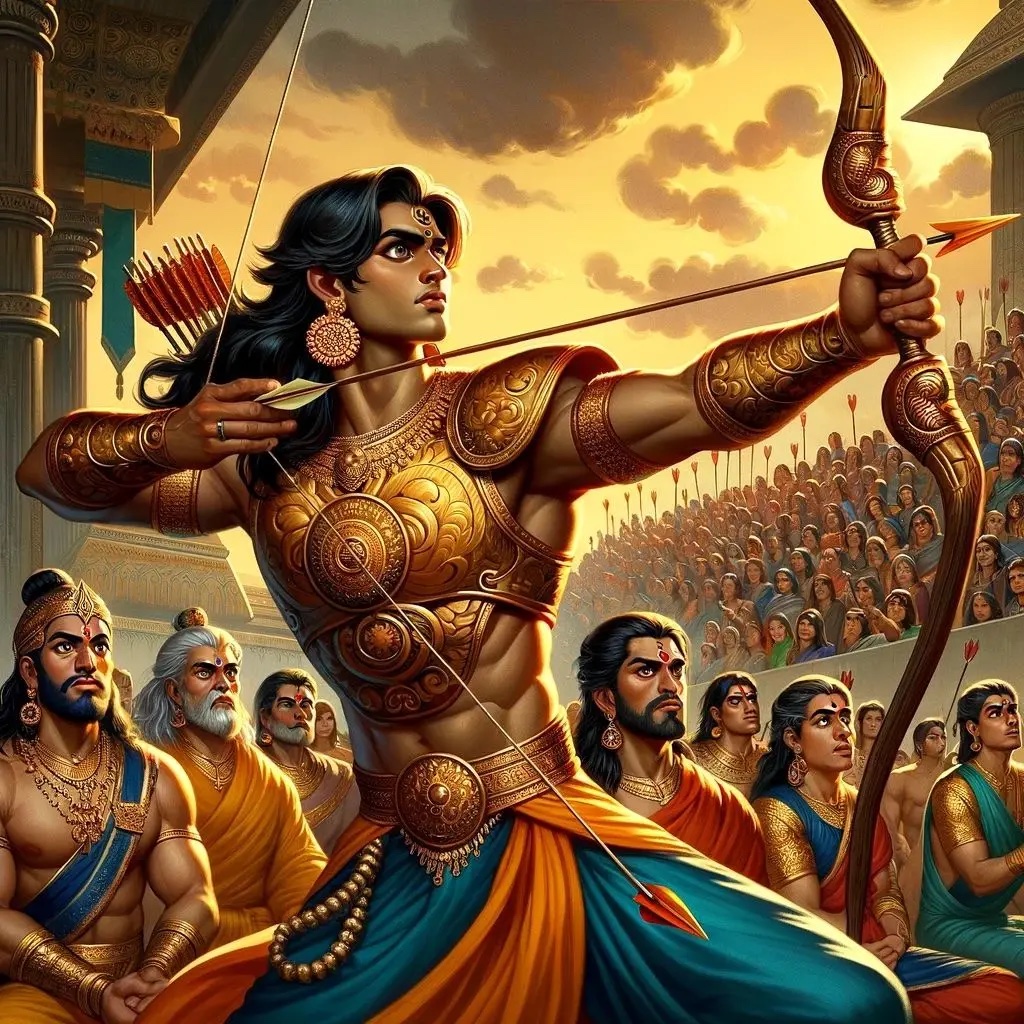
After this rigorous training, Karna’s opportunity to showcase his skills came during a tournament arranged by Drona to display the martial prowess of his students. Arjuna’s remarkable display of archery impressed the audience, but Karna saw this as the perfect moment to prove his own abilities. Entering the arena, he boldly vowed:
“I shall do everything that Arjuna has just done. In fact, I shall excel what he has done.”
Duryodhana, delighted to see someone who could rival Arjuna, supported Karna. However, Karna’s lower class origins led to his humiliation by Kripacharya, another guru of the Pandava and Kaurava cousins, who questioned his right to compete with Kshatriyas. Understanding Karna’s plight, Duryodhana immediately made him the king of Anga, declaring:
“I install Karna as the king of Anga. Now that he is a king, according to the scriptures, he is eligible to fight Arjuna.”
Draupadi’s Swayamvara
Duryodhana, his brothers, Karna, Shakuni, and others decided to attend Draupadi’s swayamvara, amarriage ceremony arranged by King Drupada of Panchala. The challenge was to lift and string a bow and shoot an arrow to pierce the eye of a golden fish by looking at its reflection in the water. All the kings failed to string the bow. Finally, Karna stepped forward, confident in his abilities.
However, there are two versions of what happened next. Some say that Karna successfully completed the challenge, but Draupadi rejected Karna due to his caste. Others assert that Karna attempted to string the bow but failed by the “breadth of a hair.” In the end, a disguised Arjuna accomplished the task and won Draupadi’s hand, leading to a series of events that made her the bride of all five Pandava brothers.
Military Exploits
Karna proved his prowess through various military campaigns, notably defeating numerous kings and earning their respect. His fame and valor continued to grow, solidifying his status as one of the greatest warriors of his time. Karna defeated kings like Drupada, Bhagadatta, and the Pandya kings, earning wealth and glory for Duryodhana. His valor in battle made him famous across Bharatvarsha, and even Jarasandha, the king of Magadha, acknowledged his prowess, gifting him the city of Malini after a fierce combat.
The Infamous Dice Game
Karna’s darker side surfaced during the infamous dice game, where Draupadi was humiliated. When Draupadi was dragged into the hall, Vikarna, one of the Kauravas, defended her, arguing that Yudhishthira had no right to bet her. Karna, however, dismissed Vikarna’s defense, saying:
“One woman should only have one husband. But this Draupadi has five husbands. Therefore, she is unchaste. Even bringing her into this court naked would be acceptable for such a woman. Disrobe Draupadi and humiliate the Pandavas!”
Despite his righteous nature, Karna’s loyalty to Duryodhana and his resentment towards the Pandavas led him to participate in Draupadi’s humiliation, marking one of the lowest points in his life.
Allegiance to Duryodhana
Karna’s bond with Duryodhana grew stronger, leading him to participate in various battles and schemes against the Pandavas. Despite knowing Duryodhana’s unrighteous path, Karna’s loyalty never wavered. He was aware of his own righteousness and noble heart but was often driven by his desire for recognition and status, which Duryodhana provided.
This loyalty was tested multiple times. When Krishna approached Karna with the revelation of his true parentage, Karna was shocked to learn he was Kunti’s son, making him a brother of the Pandavas. Krishna urged him to join his brothers, promising:
“Join the Pandava side and Yudhishthira will grant you the kingship. You will be the lord of the entire world. The sons of Pandu will be at your command. Draupadi will become your wife. You will have endless wealth!”
However, Karna, though deeply moved, responded:
“I know that Duryodhana is on the side of unrighteousness. I know that the Pandavas are ordained to win because the gods are on their side. But I cannot abandon Duryodhana. Madhava, you must understand. He has done so much for me. It would also be unrighteous to leave him.”
The Battle of Kurukshetra
Karna’s final chapter unfolded on the battlefield of Kurukshetra. As the war raged, he faced numerous adversaries, including his brothers, who were still unaware of their kinship. His promise to Kunti not to kill any Pandavas except Arjuna added layers to his tragic heroism.
The seventeenth day of battle marked Karna’s last stand. Facing Arjuna, his curses finally caused his demise. As the battle began, Arjuna and Karna engaged in a fierce duel, displaying their mastery over divine weapons. Their arrows created a spectacle in the sky, reflecting their unparalleled skills and determination.
In the midst of this intense battle, a Naga named Ashwasena, who harbored a grudge against Arjuna for the Khandava forest burning, entered the battlefield. Ashwasena secretly entered Karna’s Nagastra arrow, which Karna then shot at Arjuna. Krishna, foreseeing the danger, pressed down Arjuna’s chariot with his divine powers, causing the Nagastra to miss Arjuna’s head and instead strike his crown.
Karna then decided to invoke the Brahmastra weapon. However, as he attempted to recall the incantation, Parshurama’s curse took effect, causing him to forget the mantra. Desperate and frustrated, Karna found his chariot wheel sinking into the ground, fulfilling the Brahmin’s curse. Karna leaped out of his chariot and tried to lift the wheel, all while Arjuna continued to shower him with arrows. At this critical moment, Karna pleaded with Arjuna:
“Please, give me a moment to lift my chariot wheel. It is the right thing to do. I am unarmed, so it is wrong to attack me.”
Krishna’s response was stern, reminding Karna of his past actions:
“Where was your virtue when you insulted Draupadi in the Hastinapura court? Where was your virtue when you surrounded Abhimanyu with six other warriors? Where was your virtue when Yudhishthira was deprived of his kingdom?”
Reminded of Karna’s sins, Arjuna invoked the Anjalikastra. Karna, realizing his fate, mounted his chariot once more and attempted a final stand, countering Arjuna’s attacks with the Varunastra. Despite his efforts, Arjuna’s arrow found its mark, severing Karna’s head from his body. As Karna fell, a light emerged from his body and merged with the sun, signifying his divine origins.
Legacy
Karna’s story is a complex one. He was a man of extraordinary talent and noble intentions but was often driven by loyalty to a flawed cause, marred by his circumstances. His life invites readers to ponder whether he was a tragic hero or a victim of his own choices and fate. In the end, Karna remains one of the most compelling and tragic figures in the Mahabharata, evoking both admiration and pity.