The main conflict in the Mahabharata, an epic tale of war and deceit, is catalyzed by one man’s unparalleled cunning: Shakuni, the prince of Gandhara, and the uncle of the Kauravas. His devious plots significantly shape the course of the story, making him one of the most pivotal figures in the epic. Was he motivated only by greed and jealousy?
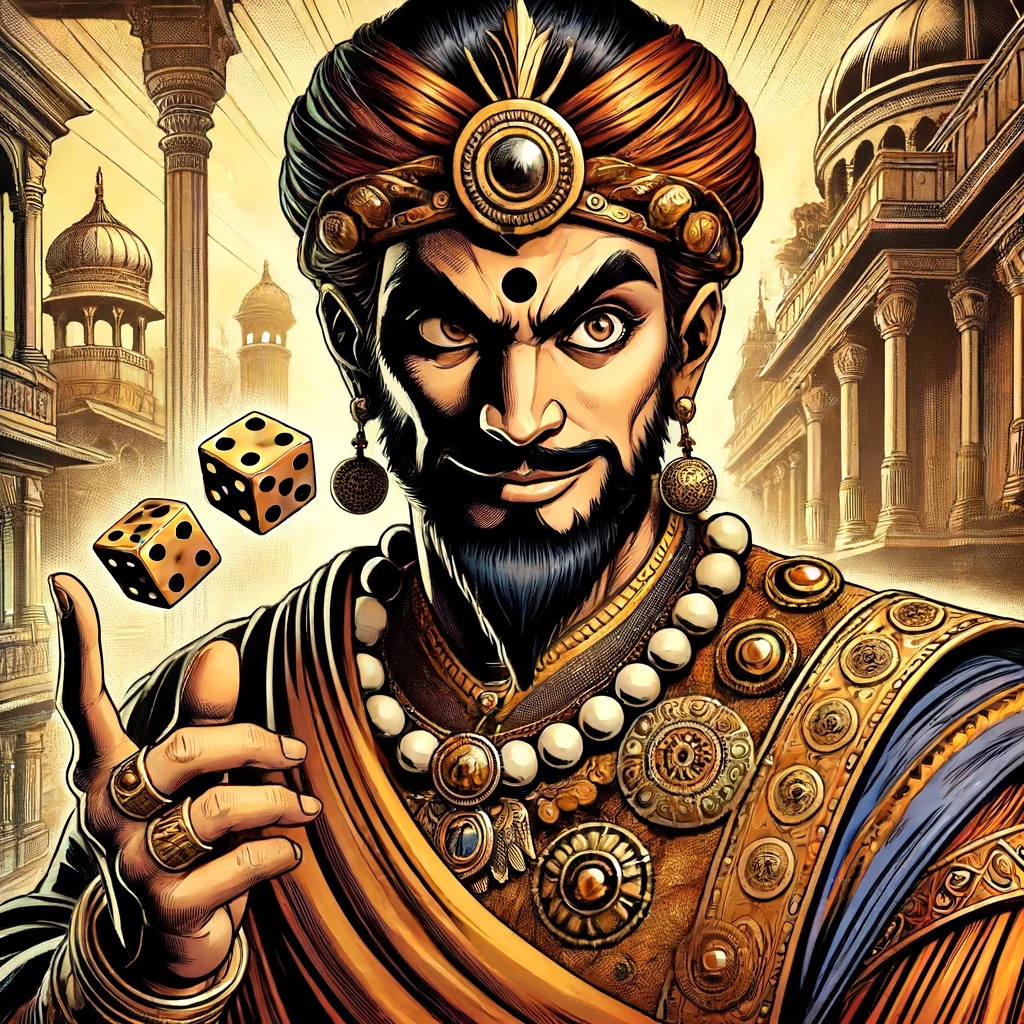
Early Life in Gandhara
Gandhara, a prosperous kingdom in the north-western region of Bharat (modern-day Peshawar basin), was known for its natural resources and strategic isolation. King Subala, Shakuni’s father, ruled this peaceful and wealthy kingdom, which had little need for a strong military. Shakuni, born to Subala and Vasumathi, was a clever and assertive boy. Despite a physical disability that gave him a slight limp, Shakuni excelled in strategic games and developed a profound skill in dice.
From a young age, Shakuni felt that his father’s lack of military focus was a mistake. Subala, however, was confident that Gandhara’s natural defenses and lack of enemies made a strong army unnecessary. This difference in opinion planted the seeds of Shakuni’s resentment and desire to prove his strategic acumen.
The Arrival of Bhishma
The tranquility of Gandhara was shattered when Bhishma, a formidable warrior from the Kuru dynasty, arrived with a marriage proposal for Shakuni’s sister, Gandhari. Bhishma sought Gandhari’s hand for Dhritarashtra, the blind prince of Hastinapura. Shakuni vehemently opposed the idea of his sister marrying a blind man:
“How can I let my sister marry Dhritarashtra? She must marry a suitable groom, not a blind and inept coward!”
Despite his objections, the marriage proceeded to avoid conflict with the powerful Kurus. Gandhari, in a show of solidarity with her husband, chose to blindfold herself permanently, vowing to share his darkness. This event marked a turning point for Shakuni. Feeling powerless and humiliated, he vowed to use his intellect to influence Hastinapura’s politics and ensure Gandhari’s well-being. He resolved to stay close to the Kuru court, subtly weaving his influence to protect his sister and manipulate events in his favor.
Shakuni’s Resolve
The perceived injustice of Gandhari’s marriage fueled Shakuni’s determination. He became a regular presence at the Kuru court, building relationships and learning the intricacies of court politics. Shakuni’s cunning and strategic mind soon made him an indispensable advisor to Dhritarashtra and his sons, especially Duryodhana.
“Bhishma has flooded my house with tears. I shall now fill his eyes with tears,” Shakuni vowed, reflecting his deep-seated need for retribution.
Shakuni nurtured a close bond with Duryodhana, guiding him in the art of deceit to challenge the Pandavas, who were seen as obstacles to Duryodhana’s ascension. Shakuni’s influence over Duryodhana grew, and together, they orchestrated numerous plots to undermine the Pandavas.
House of Lac
The rivalry between the Pandavas and Kauravas grew as they matured under the tutelage of Kripacharya and Dronacharya. Yudhishthira, the eldest Pandava, was appointed crown prince, earning the people’s love and respect. This development sparked jealousy in Dhritarashtra and Duryodhana. Seeking to eliminate the Pandavas, Duryodhana, with Shakuni’s assistance, devised a lethal plan.
“We must find a way to eliminate the Pandavas,” Duryodhana confided in Shakuni.
Shakuni, always quick with a scheme, proposed the construction of a palace made of lac, a highly flammable material. This palace would be a death trap for the Pandavas. Dhritarashtra, influenced by his son and Shakuni, sent his minister Purochana to oversee the construction of the House of Lac in Varnavrata.
Dhritarashtra began extolling the virtues of Varnavrata in the court, piquing the Pandavas’ curiosity. Sensing something amiss, Yudhishthira was hesitant but could not refuse his uncle’s invitation. Vidura, aware of the plot, discreetly warned the Pandavas and provided them with a miner to dig an escape tunnel.
When the Pandavas arrived in Varnavrata, they were warmly welcomed by Purochana. After a few weeks, Purochana set fire to the palace, believing he had rid the Kauravas of their rivals. However, thanks to Vidura’s foresight, the Pandavas escaped through the tunnel and went into hiding. Meanwhile, back in Hastinapura, Duryodhana and Dhritarashtra celebrated, thinking the Pandavas had perished. But Shakuni, ever the skeptic, suspected otherwise.
“Vidura is too wise to let such a plan succeed so easily,” Shakuni mused.
The Game of Dice
Shakuni’s mastery of dice games became the centerpiece of his most important scheme. He convinced Duryodhana to challenge Yudhishthira, the eldest Pandava, to a game of dice. Knowing Yudhishthira’s fondness for gambling, Shakuni planned to exploit this one weakness.
In the Kuru court, the game began innocuously but quickly escalated. Shakuni, playing on behalf of Duryodhana, manipulated the dice to ensure Yudhishthira’s defeat. Yudhishthira lost his wealth, his kingdom, and eventually his brothers. The game’s climax came when Yudhishthira, in a final desperate move, bet and lost Draupadi, his wife.
“You have now lost everything: except one. Draupadi, your wife, is still yours. You may bet her and win,” Shakuni cunningly suggested, sealing Draupadi’s fate in the game.
Duryodhana ordered his younger brother, Dushasana, to bring Draupadi to the court. Dushasana dragged Draupadi by her hair into the assembly hall, and ordered her disrobing. Although she was miraculously saved by Krishna, the event deepened the enmity between the Pandavas and the Kauravas.
Second Game and Exile
Despite the disastrous outcome of the first game, Dhritarashtra, overwhelmed by Draupadi’s pleas and the fear of divine retribution, relented and returned everything the Pandavas had lost. This decision infuriated Duryodhana and Shakuni.
“The blind king has undone our victory,” Shakuni lamented.
To counter this, Shakuni proposed a second game with even higher stakes: the losers would go into exile for 13 years in the forest, with the last year spent incognito. If discovered, they would repeat the exile. Once again, Shakuni manipulated the game, ensuring the Pandavas’ defeat. The Pandavas were exiled, and Duryodhana became king. However, after their exile the Pandavas vowed to return and reclaim their kingdom, setting the stage for the great war of Kurukshetra.
The Kurukshetra War
When the Pandavas’ exile ended, war became inevitable when Duryodhana refused to concede even five villages from his kingdom. Shakunibrought his forces from Gandhara to support the Kauravas. He also brought his son, Uluka, and his brothers to the battlefield. Despite his preference for cunning over open conflict, Shakuni played a strategic role in the war. He used his skills in illusion and sorcery to counter the Pandavas’ attacks, but his efforts were ultimately in vain against the Pandavas’ valor and divine support.
The 18th day of the war marked the end for Shakuni. Sahadeva, one of the Pandavas, had vowed to kill Shakuni to avenge the wrongs done to his family. In a fierce battle, Sahadeva pursued Shakuni, who tried to flee. Ultimately, Sahadeva caught up with him and beheaded him, fulfilling his vow.
As Shakuni lay dying, he realized the futility of his schemes. His relentless pursuit of vengeance and manipulation had led to his own demise and the destruction of his family. In his final moments, Shakuni understood that his actions, driven by attachment to his sister and nephew, had brought about his downfall.
Legacy
Many portrayals depict Shakuni as a figure driven solely by revenge. However, his primary motive was the happiness of his sister, Gandhari. Though he resented her marriage to Dhritarashtra, his actions aimed at elevating Duryodhana and securing his mother Gandhari’s status.
Shakuni’s life and actions in the Mahabharata underscore the complex interplay of loyalty, ambition, and the consequences of unchecked enmity. His legacy as the master conspirator continues to intrigue and captivate audiences, revealing the depths of human ambition and the lengths one might go to protect loved ones.