A master strategist, compassionate friend, and spiritual guide, Krishna’s life weaves through the epic Mahabharata like a brilliant thread, illuminating the eternal struggle between right and wrong. Born in a prison cell under the shadow of a tyrant’s sword, Krishna’s life was extraordinary from its very first breath. From the idyllic cow pastures of Vrindavan to the war-torn fields of Kurukshetra, Krishna’s journey is a testament to the intricate dance between divine will and human choice.
A Divine Prophecy
In the ancient land of Mathura, an evil king named Kamsa ruled with an iron fist until a prophecy foretold his downfall. On the day of his sister Devaki’s wedding to Vasudeva, a heavenly voice proclaimed that the couple’s eighth child would be Kamsa’s destroyer. This revelation shattered the festive atmosphere, plunging Kamsa into a pit of fear and paranoia.
The divine voice was clear and specific: it was not just any child, but the eighth child of this particular couple who would bring about his downfall. Driven by his desperate desire to cling to power, Kamsa imprisoned the newlyweds and systematically killed their first six children. However, fate intervened when the seventh, Balarama, was secretly transferred to the womb of Rohini, another of Vasudeva’s wives. As the birth of the eighth child approached, tension mounted, and Kamsa’s determination to thwart the prophecy grew ever stronger.
Miraculous Escape
On a stormy night, as lightning split the sky and thunder shook the earth, Krishna came into the world. His parents, Devaki and Vasudeva, marveled at their newborn son, his skin as blue as the midnight sky, even as fear gripped their hearts. But fate had other plans. In a moment of divine intervention, the prison guards fell into a deep slumber. The chains that bound Vasudeva miraculously fell away. Seizing the opportunity, he cradled his infant son and slipped into the tumultuous night.
“Protect him, O Lord,” Devaki whispered tearfully as Vasudeva disappeared into the storm.
Outside, the storm raged with unprecedented fury. The raging Yamuna river, swollen with monsoon rains, blocked Vasudeva’s path. Yet, as he approached the riverbank, a miracle occurred. The turbulent waters parted before him, creating a safe passage. Above, the great serpent Shesha appeared, spreading its hood to shelter the divine infant from the relentless rain.
Guided by divine will, Vasudeva reached the village of Gokul. There, he found the home of Nanda and Yashoda, simple cowherds with hearts of gold. Yashoda had just given birth to a daughter but had fallen into a deep sleep, unaware of the child. Vasudeva swiftly exchanged the infants, leaving Krishna in the care of his new foster parents and taking the girl child back to the prison in Mathura.
As Vasudeva returned, the prison gates locked themselves, the guards awoke, and the chains reappeared on his wrists. The girl child began to cry, alerting the guards. When Kamsa arrived to kill the newborn, the infant slipped from his grasp, transformed into the goddess Yogamaya, and warned him that his destroyer was already born and safe.
The Mischievious Boy
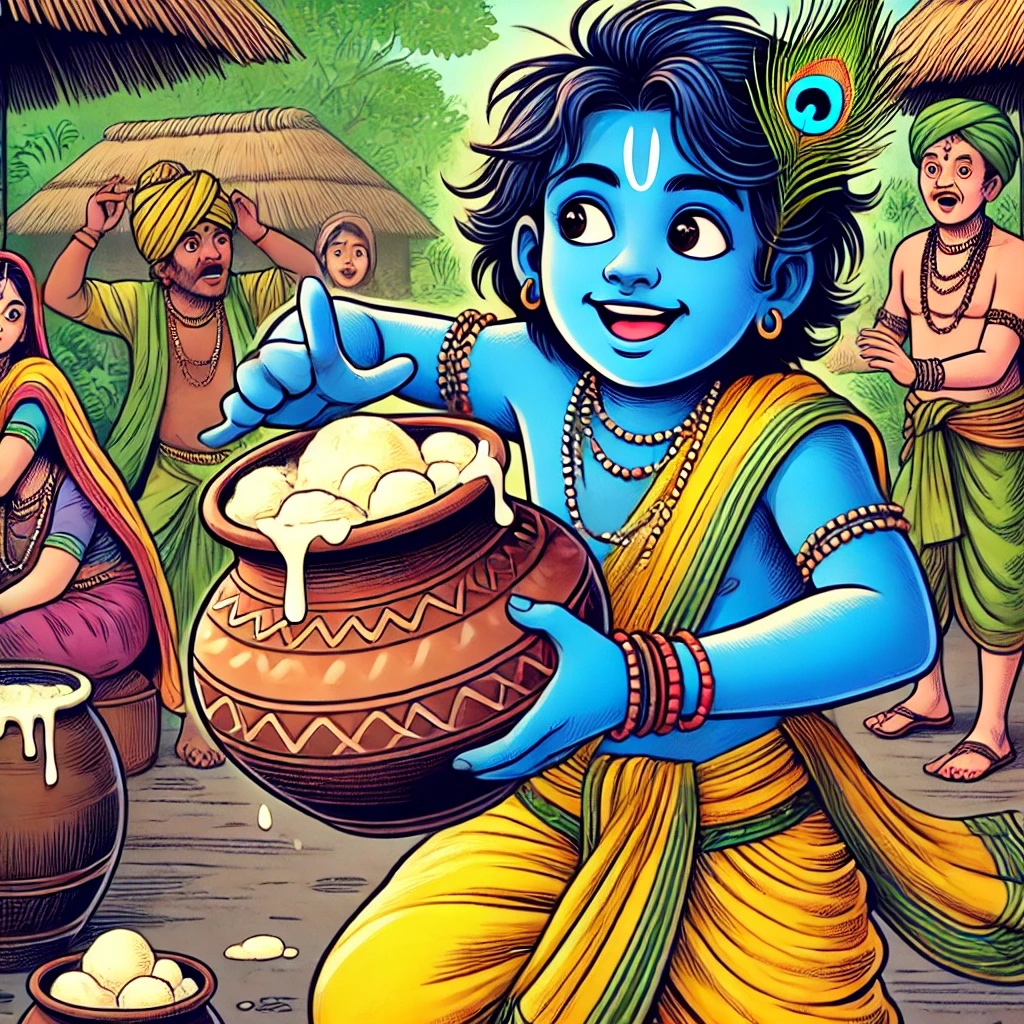
Under the loving gaze of his adoptive parents, Krishna blossomed into a mischievous and charming child. His skin, blue as sapphires, and his enchanting smile captivated everyone in Gokul. The villagers soon found their butter pots mysteriously emptied, earning Krishna the affectionate nickname Makhan Chor (the Butter Thief).
“Krishna, you naughty boy!” Yashoda would exclaim, trying to hide her smile. “What am I to do with you?” To which Krishna would reply with a cheeky grin, “But mother, the butter was calling out to me!”
Krishna’s pranks became legendary. He would sneak into houses, climbing on top of each other to form human pyramids, to reach the pots of butter and curd hung from the ceiling. When caught, his innocent smile and playful excuses always melted the hearts of even the most exasperated villagers.
His mischief wasn’t limited to stealing butter. Krishna loved playing tricks on the gopis (milkmaids) of Vrindavan. He would hide their clothes while they bathed in the river, returning them only after extracting promises of sweets and devotion. These playful antics, known as Krishna’s “lilas” or divine play, filled the air with laughter and joy, endearing him to all.
Childhood Exploits
As Krishna grew into a young boy, so did his legendary exploits. As an infant, he vanquished the demoness Putana, who attempted to poison him with her breast milk. Disguised as a beautiful woman, Putana had been sent by Kamsa to kill all newborns. When she offered her poisoned breast to Krishna, he accepted it but sucked with such force that he drew out her life along with the milk, revealing her true demonic form.
Later, the poisonous serpent Kaliya had made its home in a deep pool of the Yamuna river, poisoning the waters and endangering the villagers and their cattle. Without hesitation, the young Krishna dove into the murky waters. A fierce battle ensued, with Kaliya attempting to crush Krishna in its coils. But Krishna, with his divine strength, expanded his body, forcing the serpent to release him.
Then, in a spectacular display of courage and grace, he danced upon Kaliya’s many heads, his feet striking with such force that the serpent began to weaken. The naginis (female serpents), wives of Kaliya, pleaded for mercy. Krishna, in his compassion, spared Kaliya’s life but banished him from the Yamuna, thus purifying the river and saving the village.
Lifting Govardhan Hill
One seasion, Indra, the king of the gods, sent torrential rains to punish the villagers for not worshipping him. Krishna, seeing the devastation the rains were causing, decided to teach Indra a lesson in humility and protect his people.
“Fear not,” Krishna reassured the villagers. “I shall protect you all.”
With a serene smile, Krishna approached the massive Govardhan Hill. To the astonishment of the villagers, he lifted the entire mountain with his little finger, providing shelter to the entire village and their cattle. For seven days and nights, he held the mountain aloft, a living shield against Indra’s fury.
Indra, realizing he was powerless against Krishna’s divine might, finally relented. The rains stopped, and Krishna gently set the mountain back in its place. This miraculous act not only saved the villagers but also taught a powerful lesson about the true nature of devotion and protection.
The Death of Kamsa
As Krishna approached adolescence, the time came to fulfill his destiny. With his brother Balarama by his side, he journeyed to Mathura to confront his uncle, King Kamsa. The city buzzed with excitement as news spread of the divine brothers’ arrival.
Kamsa, in a last attempt to thwart the prophecy, organized a great wrestling competition, planning to have Krishna killed in the arena. In the royal arena, Krishna faced Kamsa’s mighty wrestlers, Chanura and Mushtika. Despite their size and strength, Krishna and Balarama defeated them with effortless grace, their movements resembling a divine dance more than a wrestling match.
The climax cameas Krishna leaped onto Kamsa’s throne. With lightning speed, he grabbed the tyrant by the hair and hurled him to the ground. With a single blow, Krishna ended Kamsa’s reign of terror. The people of Mathura rejoiced, and Krishna’s parents, Devaki and Vasudeva, were finally freed from their long imprisonment.
Meeting the Pandavas
In the years following Kamsa’s defeat, Krishna’s fame spread far and wide. He became known not just as a warrior and prince, but as a diplomat, philosopher, and spiritual guide. His counsel was sought by kings and commoners alike, and his adventures continued to captivate the hearts of people across the land.
Meanwhile, the rivalry between the Pandavas and the Kauravas, two branches of the same royal family, was growing more intense. Krishna, related to both sides through his father’s sister Kunti, watched these developments with growing concern.
Finally, Krishna attended Draupadi’s swayamvara, along with other kings and princes from across the land. Among the attendees, Krishna’s keen eyes spotted five Brahmins who seemed oddly familiar. With his divine insight, he recognized them as the Pandavas in disguise, living in exile after escaping the attempt on their lives at the House of Lac.
Krishna eventually (as Kunti was the sister of Vasudeva, Krishna’s father), made his way to the potter’s house, where Kunti and the Pandavas were residing in hiding. He arrived at the threshold, his presence illuminating the modest dwelling.
“Aunt Kunti,” he called out gently, “I have come to see you and your sons.”
Kunti, recognizing Krishna, welcomed him with reverence and joy. Krishna learned of Kunti’s unwitting command and the marriage of the fivebrothers with Draupadi. Seeing the concern on their faces, he smiled reassuringly. “The ways of dharma are complex,” he said. “Trust that this unusual arrangement is part of a greater divine plan. Your unity will be your strength.”.
Legacy
This pivotal meeting marked the beginning of Krishna’s profound relationship with the Pandavas, a bond that would shape the course of the Mahabharata. As the epic unfolded, Krishna became an indispensable ally to the Pandava brothers, serving as their advisor, protector, and moral compass. His wisdom guided them through the establishment of their kingdom, Indraprastha, and later, through the tumultuous events leading to the great war of Kurukshetra. Krishna’s role transcended that of a mere ally, embodying divine intervention in human affairs, most notably as Arjuna’s charioteer and the imparter of the Bhagavad Gita’s profound wisdom.
Krishna’s actions and teachings offer timeless lessons on the importance of dharma, the power of divine grace, the complexity of morality, the value of detachment, and the strength of unity. His journey from the miraculous child of Vrindavan to the divine counselor of the Mahabharata continues to inspire millions, offering guidance on navigating the complex moral dilemmas of human existence and the path to spiritual enlightenment. In the story of his life, we find not just the tale of a god among men, but a profound exploration of what it means to live a life of purpose, duty, and ultimate devotion.