After Draupadi’s swayamvara, the Pandavas returned to Hastinapura, their true identities now revealed to the world. The streets buzzed with excitement as citizens caught glimpses of the long-lost princes and their new bride.
Dhritarashtra, the blind king and father of the Kauravas, found himself in a difficult position. He addressed his court, saying, “The return of my brother’s sons brings me great joy, yet I fear the conflict that may arise between them and my own children.”
Division of the Kingdom
Bhishma, the respected elder of the Kuru clan, proposed a solution to maintain peace: “Let the kingdom be divided. Grant the Pandavas a portion of the land to rule, so that both branches of the family may prosper.”
After much deliberation and behind-the-scenes maneuvering, Dhritarashtra agreed to this proposal. Finally, Dhritarashtra announced, “To my nephew Yudhishthira and his brothers, I grant the region of Khandavaprastha. May they rule it wisely and make it prosper.”
A City Takes Shape
The land granted to the Pandavas, Khandavaprastha, was a wild and untamed forest region far from the opulent capital of Hastinapura. Many considered it uninhabitable, but the Pandavas saw potential where others saw only wilderness.
Upon first seeing their new domain, Arjuna’s optimism shone through. “Brothers,” he declared, his eyes alight with vision, “here we shall build a city to rival the abodes of the gods themselves!”
Yudhishthira, ever the wise leader, replied, “We have been given more than just land,” he mused, his voice filled with purpose. “This is our opportunity to transform this wilderness into a kingdom that will be the envy of the world.”
The other brothers, inspired by these words, nodded in agreement. Bhima, always eager for action, grinned broadly and flexed his mighty arms. “Well then,” he boomed, “shall we begin by clearing some trees?”
With Yudhishthira’s wisdom guiding them, they began to draw up plans for their new home. His vision was grand yet practical: wide streets to accommodate the flow of people and goods, majestic buildings to house their growing population, and lush gardens to bring beauty and serenity to urban life.
Price of Progress
The once-lush forest began to shrink rapidly under Bhima’s powerful strikes. Ancient trees that had stood for centuries fell in minutes. The air filled with the sounds of splintering wood and the cries of disturbed animals. A old forest dweller lamented, “The forest weeps as its children are felled. What will become of those who called this place home for generations?”
The wildlife, sensing the encroachment on their habitat, began to flee. Herds of deer, sounders of wild boar, and flocks of brilliantly plumed birds moved deeper into the remaining forest or migrated to distant lands. Arjuna, despite his role in the clearance, felt a pang of regret. “We bring civilization,” he mused, “but at what cost to nature’s delicate balance?”
The transformation wasn’t limited to the forest alone. As construction began, the very landscape was altered. Hills were leveled, rivers diverted, and lakes drained or created as needed. The natural contours of the land gave way to the geometric precision of urban planning.
Yudhishthira, ever mindful of dharma, struggled with the moral implications. He confided in his brothers, “We destroy one home to build another. How do we justify this to the creatures who cannot speak for themselves?”
Nagas Challenge
As construction progressed, the Pandavas encountered an unexpected obstacle. While digging foundations, workers uncovered an ancient underground chamber inhabited by Nagas, serpent-beings led by their chief, Vasuki.
Vasuki emerged, declaring, “Halt your work. This land has been our ancestral home since time immemorial.”
While Bhima was ready to fight, Yudhishthira chose diplomacy. He addressed Vasuki respectfully, “Noble one, we seek not to displace you, but to coexist. Let us build a city where both our peoples can thrive.”
Yudhishthira proposed incorporating the Nagas’ dwellings into the city plans, creating grand underground chambers connected to the surface. In return, he asked for their wisdom and aid in building Indraprastha.
Impressed by this approach, Vasuki agreed. “In all my centuries, I have never met a human with such wisdom and foresight. We accept your proposal.”
The Nagas shared their knowledge of architecture and earth-craft, helping create a network of underground structures that rivaled the grandeur above ground. In return, they became respected citizens of the new city.
Haven of Dharma
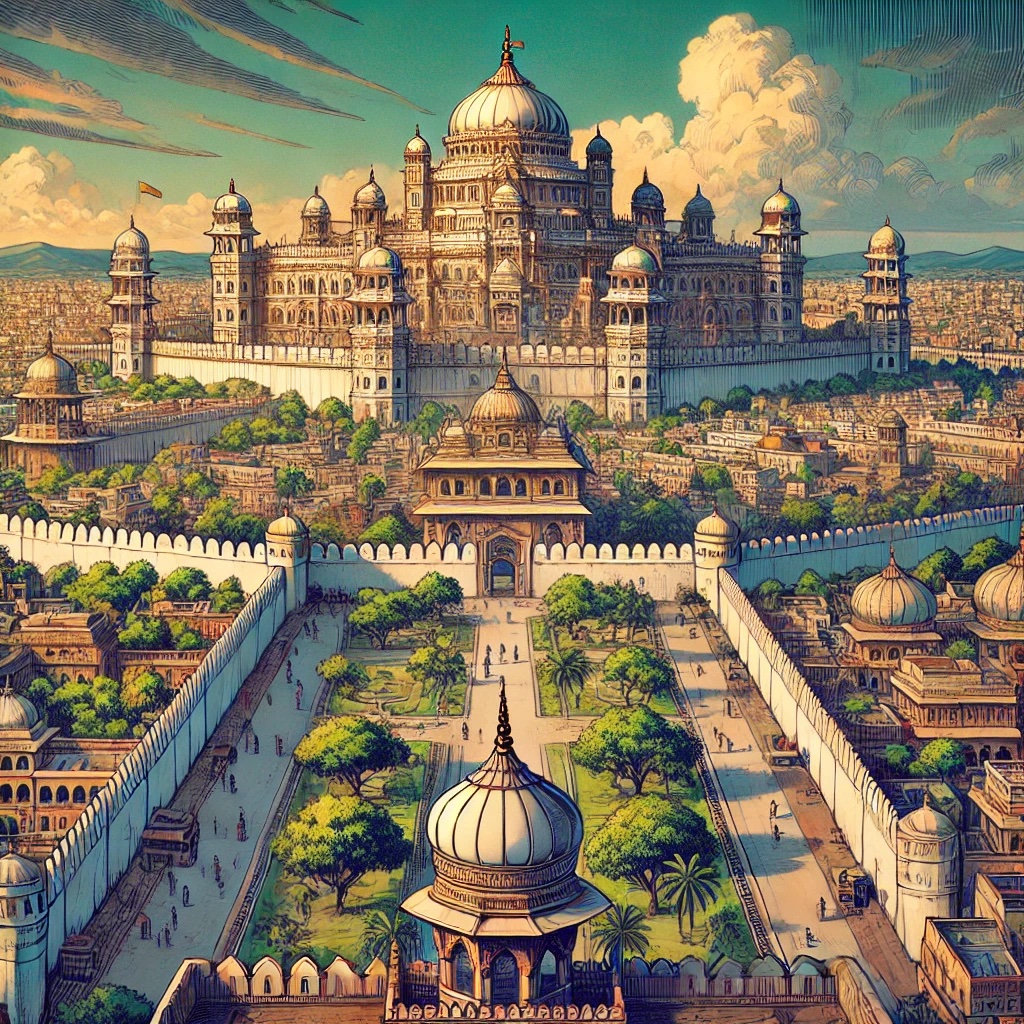
Months turned into years, and slowly but surely, Indraprastha rose from the forest floor. Its walls gleamed white in the sun, its towers reached towards the sky, and its streets bustled with life. The Pandavas decided to call the city Indraprastha, “The City of Indra,” a name that reflected their ambition to create a city that rivaled that of the King of Gods.
At the heart of the city stood the great hall, a marvel of architecture that seemed to shimmer with an otherworldly beauty – a gift from the divine architect, Maya. A visiting merchant exclaimed, “By the gods! This city outshines even the legendary Amaravati of Lord Indra!”
Under Yudhishthira’s just rule, Indraprastha became known as a haven of dharma. The weak found protection, the hungry were fed, and disputes were settled fairly. A grateful citizen was heard saying, “In Indraprastha, even the poorest man can find justice, and the weakest can sleep without fear.”
Rajasuya Yagna
As the Pandavas’ power and influence grew, they set their sights on the ultimate symbol of sovereignty – the Rajasuya Yagna. This grand sacrifice would establish Yudhishthira as a paramount king, a feat that had not been achieved in generations.
As the day of the yagna approached, Indraprastha buzzed with activity. Messengers were dispatched to the far corners of Bharatavarsha, inviting kings and nobles to witness the grand event. The city itself was transformed, adorned with flowers and festive decorations, its streets cleaned and buildings freshly painted.
On the appointed day, the great assembly hall of Indraprastha filled with royalty from across the land. Krishna, honored as the first recipient of gifts, sat in a place of prominence. The air was thick with the scent of incense and the chanting of priests as they began the elaborate rituals.
Yudhishthira, resplendent in royal attire, was anointed with sacred waters brought from various holy rivers and seas. As the holy water trickled down his forehead, a visible change came over him – no longer just a king, but an emperor blessed by the gods.
As the yagna drew to a close, the assembled kings paid homage to Yudhishthira, acknowledging his supremacy. The Pandavas had reached the pinnacle of their power, their journey from exiles to emperors complete.
Conclusion
As the celebrations of the Rajasuya Yagna concluded, the Pandavas stood atop the walls of their city, looking out at the bustling metropolis they had created from wilderness. The transformation was undeniable – where once stood ancient trees, now rose magnificent buildings; where animals once roamed freely, citizens now went about their daily lives.
Yudhishthira turned to his brothers, his voice tinged with both satisfaction and a hint of melancholy. “Look at what we have achieved together,” he said. “This is not just a city of stone and mortar, but a testament to what can be accomplished with unity, perseverance, and adherence to dharma. Yet, we must never forget the cost at which this progress came.”