In the ancient kingdom of Panchala, a grand spectacle was about to unfold. King Drupada had announced a swayamvara – a ceremony where a bride chooses her husband – for his daughter, the beautiful Draupadi. But this was no ordinary event. The challenge set before the suitors was formidable: to string a massive bow and shoot an arrow through the eye of a rotating fish, guided only by its reflection in a pool of oil. This test befitted the extraordinary bride herself, for Draupadi was no ordinary princess.
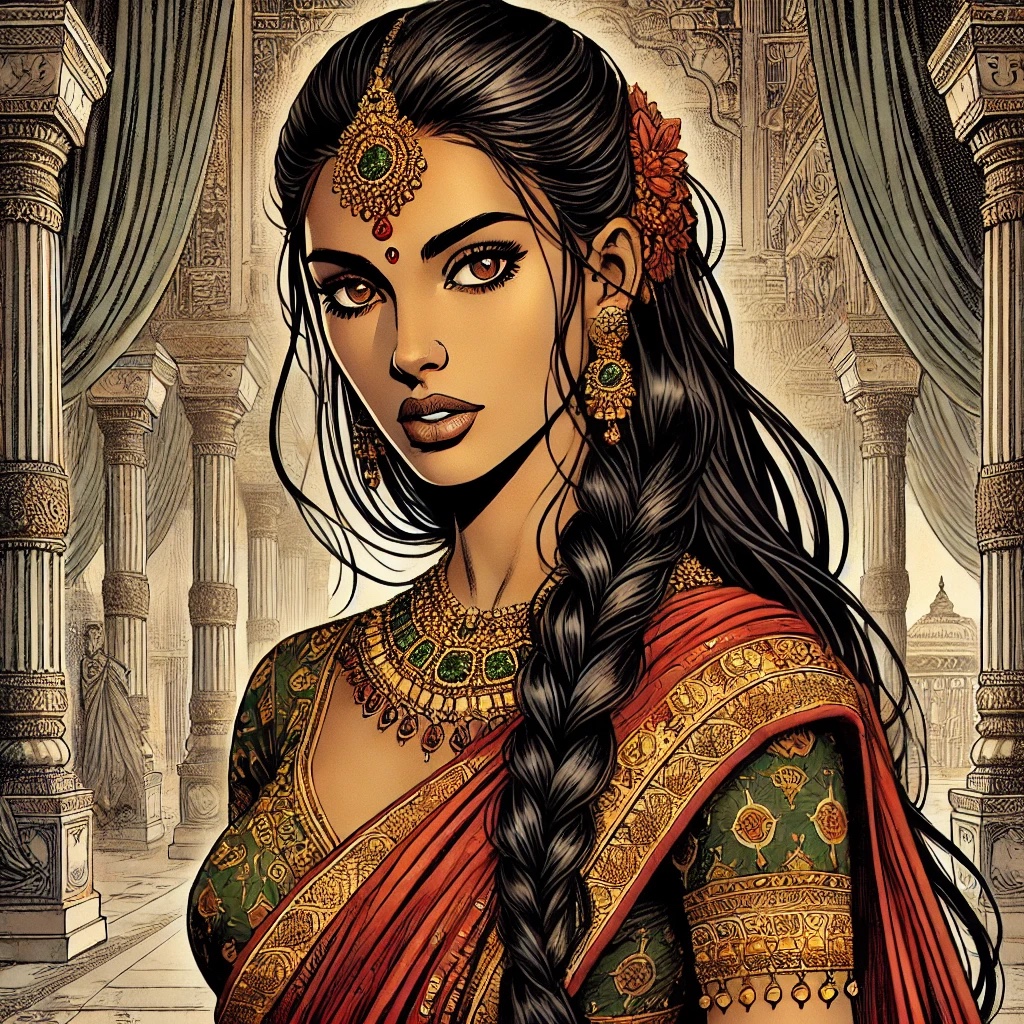
Draupadi’s Birth and Prophecy
Draupadi was born from a sacrificial fire during a yajna performed by King Drupada of Panchala, who sought a powerful ally to avenge his humiliation at the hands of Drona, the royal teacher of the Kuru princes. Draupadi emerged from the fire, alongside her brother Dhrishtadyumna, with a divine aura and unparalleled beauty. A celestial voice proclaimed her destiny: “Draupadi, born from fire, shall be a catalyst in the great saga of the Mahabharata. Her destiny will be intertwined with the fate of the Kuru dynasty.”
As Draupadi reached marriageable age, King Drupada announced a grand swayamvara, inviting princes and kings from across Bharatvarsha to compete for her hand. The swayamvara was designed to be a test of valor and skill, befitting a bride of Draupadi’s stature.
The Arrival of the Pandavas
Living in exile after escaping the burning of the House of Lac, the Pandavas, along with their mother, Kunti, wandered through various kingdoms as in disguise. One day, as they traveled, they encountered a group of Brahmins who were discussing a grand event that had captured the attention of the entire region. These Brahmins spoke of the swayamvara of Draupadi, the beautiful and virtuous daughter of King Drupada of Panchala. The event promised to be a magnificent gathering of the most noble and valorous princes and kings from across Bharatvarsha, all competing for Draupadi’s hand in marriage through a formidable test of skill.
“The challenge is extraordinary,” one Brahmin said. “The suitor must string a mighty bow and shoot an arrow through the eye of a rotating fish, using only its reflection in a pool of oil below. It is a task only the greatest archer can achieve.”
Hearing of this spectacular challenge, Arjuna, the third Pandava and a master archer, was particularly eager to test his skills. Disguised in the simple, unassuming attire of Brahmins, the Pandavas made their way to Panchala, and joined the crowd of noble suitors gathering for the grand event.
An Impossible Task
The swayamvara hall was filled with the most illustrious kings and princes, each eager to win Draupadi’s hand. Among them were Karna, the prince of Anga; Duryodhana, the eldest Kaurava; Shalya, the king of Madra; and many others. Draupadi entered the hall, radiant and poised, her presence commanding attention and admiration.
The bow used in the swayamvara was no ordinary weapon. According to legend, the Pinaka bow was once wielded by Lord Shiva himself, and its power and might were unmatched. The suitors had to use this bow to shoot an arrow through the rotating fish’s eye, but they could only aim using its reflection in a pool of oil below. This task required not only strength and skill but also immense concentration and precision.
As the competition began, many suitors stepped forward to string the mighty bow, but one by one, they failed. Some could not even lift the bow, others were not able to pull the string to arm it. Out of all the assembled kings and princes, Karna came the closest, but barely failed to string the bow. The swayamvara seemed destined to end in disappointment until Arjuna, still disguised as a Brahmin, rose to take his turn
Arjuna’s Triumph
Arjuna’s calm demeanor and confidence stood in stark contrast to the frustration of the other suitors. He approached the bow with reverence and ease, invoking blessings from the gods and his mentors. With a fluid motion, he strung the bow and took aim at the rotating fish’s eye, using its reflection in the pool of oil.
With unwavering focus and precision, Arjuna released the arrow. It soared through the air, striking the fish’s eye with flawless accuracy. The hall erupted in astonishment and applause as Arjuna’s victory became clear.
“The Brahmin has done it! He has accomplished the impossible task!” exclaimed the onlookers.
The Revelation and Marriage
As soon as Arjuna hit the target, murmurs of protest arose from the gathered kings and princes. They could not believe that a mere Brahmin had accomplished such a feat, and suspicion grew regarding Arjuna’s true identity.
“This is impossible! How can a Brahmin string the mighty Pinaka and hit the target with such precision?” exclaimed Duryodhana, his voice laced with disbelief and jealousy.
King Drupada, observing the unrest, addressed the assembly, “Noble warriors, this swayamvara was open to all who possess the valor and skill to win Draupadi’s hand. This Brahmin has proven his worth. However, if there are any doubts, let him reveal his true identity.”
With the hall in a state of heightened anticipation, Arjuna, along with his brothers, stepped forward. They revealed their true identities as the Pandavas, the sons of King Pandu of Hastinapura. The revelation stunned the assembly, turning disbelief into awe.
King Drupada was both relieved and overjoyed to learn that his daughter would marry a prince of such noble lineage. With King Drupada’s blessings, Draupadi and Arjuna were married in a grand ceremony, celebrating their union.
One Wife for Five Brothers
Upon his victorious return from the swayamvara, Arjuna, filled with pride and joy, carried Draupadi to their humble abode. Eager to share the news with their mother, Kunti, he called out, “Mother, see what I have brought!” Kunti, preoccupied with her thoughts and unaware of the specifics, responded absent-mindedly, “Share it equally among your brothers.”
This casual remark placed the Pandavas in a moral and ethical dilemma, balancing the conventional structure of marriage and their obligation to follow their mother’s wishes. After much contemplation and consultation with revered sages, the Pandavas decided to live by Kunti’s command. Draupadi, with grace and humility, accepted her unique role, understanding the deeper destiny that intertwined her life with that of the Pandavas.
Legacy
Draupadi’s swayamvara is a tale of valor, fate, and the profound impact of individual actions on the course of history. Arjuna’s triumphant success in winning her hand showcased his unparalleled skill, and Draupadi, with her radiant beauty and humble grace, stood as a symbol of dignity and virtue. Her life serves as a reminder of the complexities of human relationships, and the role of destiny, skill and strength of character to shape the course of history.