Ekalavya was a master archer who, despite being rejected by the great teacher Drona due to his social status, honed his skills through sheer dedication and self-taught practice. His humility and dedication are exemplified by his willingness to sacrifice his thumb to fulfill Drona’s gurudakshina. The story of Ekalavya’s life highlights the tragic intersection of caste, loyalty, and politics in the Mahabharata. What could Ekalavya have achieved if his potential was not cut short by the societal prejudices of his time?
Birth and Adoption
Ekalavya’s birth is recounted in the Harivamsa, Harivamsa Parva, Chapter 34. His father, Devashrava, was the brother of Vasudeva, making him a cousin to the mighty Krishna. His mother was Kamsavati. “For an unknown reason, his parents abandoned him at a young age,” says the Harivamsa. He was discovered and adopted by King Hiranyadhanus of the Nishadhas, a tribe living in the forest.
Despite his royal lineage, Ekalavya was raised in the humble surroundings of the forest, under the care of his foster father. This upbringing instilled in him a deep connection to nature and an unyielding resilience. His foster father, Hiranyadhanus, recognized his potential and nurtured his early interest in archery, shaping his initial steps towards greatness.
Mastery of Archery
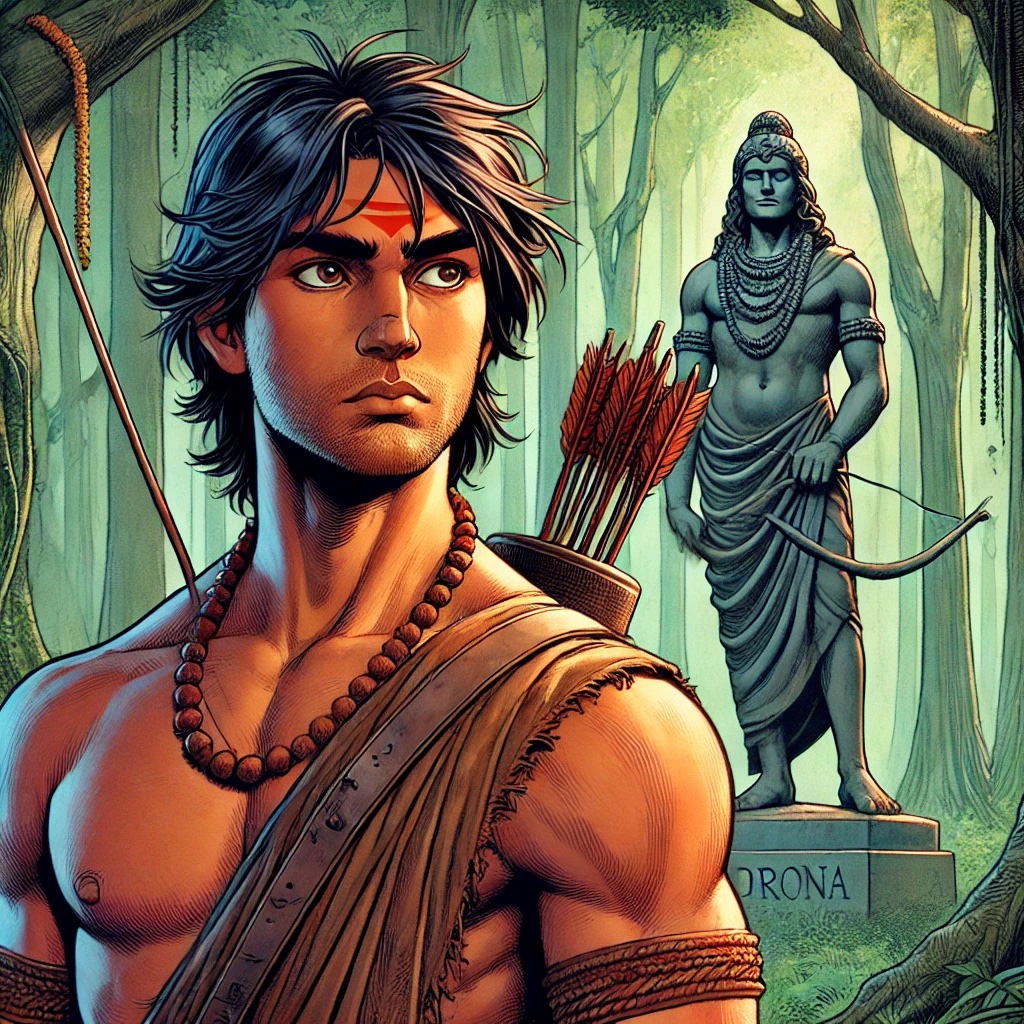
Seeking the best possible training, Ekalavya approached Drona, the esteemed teacher of the Pandavas and Kauravas, and humbly requested to be his pupil. Drona’s response, however, was curt and dismissive: “You are a low-caste Nishadha. Therefore, I unfortunately cannot accept you.” Despite this rejection, Ekalavya’s resolve remained unshaken. He constructed a clay statue of Drona in the forest and treated it as his real teacher, practicing rigorously every day.
Through sheer dedication, Ekalavya achieved unparalleled skills in archery. He became renowned as the greatest archer of his time, a title he earned through relentless self-discipline and practice. “His devotion to his art and his determination made him a formidable archer, respected and feared by many,” recounts the Mahabharata, in chapter 123.
Drona’s Gurudakshina
One day, while hunting in the forest, the Pandavas and Kauravas encountered a dog whose mouth was expertly sealed with arrows, yet unharmed. Astonished, they sought out the archer responsible and found Ekalavya practicing in the forest.
Introducing himself as a pupil of Drona, Ekalavya’s claim troubled Arjuna. “Earlier, you had promised me that I would be your greatest pupil. Why then is Ekalavya superior to me?” Arjuna questioned Drona.
Drona, accompanied by Arjuna, went to meet Ekalavya. He demanded, “Ekalavya, if you are truly my pupil, then you must give me gurudakshina.” Ekalavya, ever loyal, responded, “Guruji, I am grateful to have the opportunity to give you something. Ask for anything, and I shall give it.” Drona’s response was severe and unust: “Well then, give me your right thumb.”
Without hesitation, Ekalavya severed his right thumb, a sacrifice that ensured Arjuna’s supremacy. “This act of self-sacrifice, though it diminished his prowess, highlighted his discipline and unwavering dedication to his guru.
Joining Jarasandha against Krishna
Despite losing his right thumb, Ekalavya did not abandon his passion for archery. He adapted his technique to accommodate his disability, continuing to practice and improve his skills.
He eventually joined forces with Jarasandha, the powerful king of Magadha, who was the sworn enemy of Lord Krishna, who was the Pandava’s maternal uncle. Jarasandha ruled over a vast kingdom and commanded the allegiance of numerous other kings.
Jarasandha’s enmity towards Krishna stemmed from Krishna’s killing of Kansa, Jarasandha’s son-in-law. To avenge this, Jarasandha launched multiple attacks against Mathura, Krishna’s home base. Ekalavya was instrumental in these military campaigns, demonstrating his strategic acumen and combat prowess.
Death at Krishna’s Hands
Eventually Krishna was forced to move his capitol to Dwarka, on the Western coast of India, due to the continuous attacks from Jarasandha and his allies. After Jarasandha was killed by Bhima (with Krishna’s support), Paundraka Vasudeva, an ally of Jarasandha, launched an attack on Dwarka. Ekalavya supported this attack, bringing a large army to challenge Krishna’s forces.
Krishna swiftly defeated Paundraka and pursued Ekalavya, who tried to flee. However, Krishna’s pursuit was relentless. “Krishna chased Ekalavya and eventually caught up. Krishna smashed him against a rock and killed him,” recounts the Harivamsa. This brutal end marked the demise of one of the greatest archers of his time.
Krishna’s justification for killing Ekalavya is revealed in the Drona Parva of the Mahabharata. He tells Arjuna: “If Jarasandha, the king of Chedi and the immensely strong Nishadha (Ekalavya) had not been killed earlier, they would have become terrible now. There is no doubt that Suyodhana (Duryodhana) would have chosen them as his allies.”
Krishna further explains, “Ekalavya was as resplendent as a second Rama in the forest. O Partha! Had Ekalavya possessed his thumb, the gods and the danavas, with the rakshasas and the serpents, would never have been able to defeat him in a battle.”
Conclusion
Ekalavya’s story is a powerful testament to dedication, sacrifice, and the harsh realities of societal structures. Ekalavya’s loyalty to his guru, even at the cost of his own greatness, and his strategic alliance with Jarasandha, showcase his complex character. His tragic end at the hands of Krishna, underscores the brutal realities of the Mahabharata war. “His fist was firm and he could continuously shoot, throughout the day and night. How could a mere human have looked at him? It is for your sake that I killed him in the field of battle,” Krishna’s words to Arjuna highlight the tragic intersection of destiny and political intrigue.
Ekalavya remains an emblem of selfless dedication and the ultimate sacrifice, a figure whose legacy transcends time, inspiring countless generations. His life and death serve as poignant reminders of the virtues of dedication and the often harsh consequences of unwavering loyalty in the face of societal and political constraints.